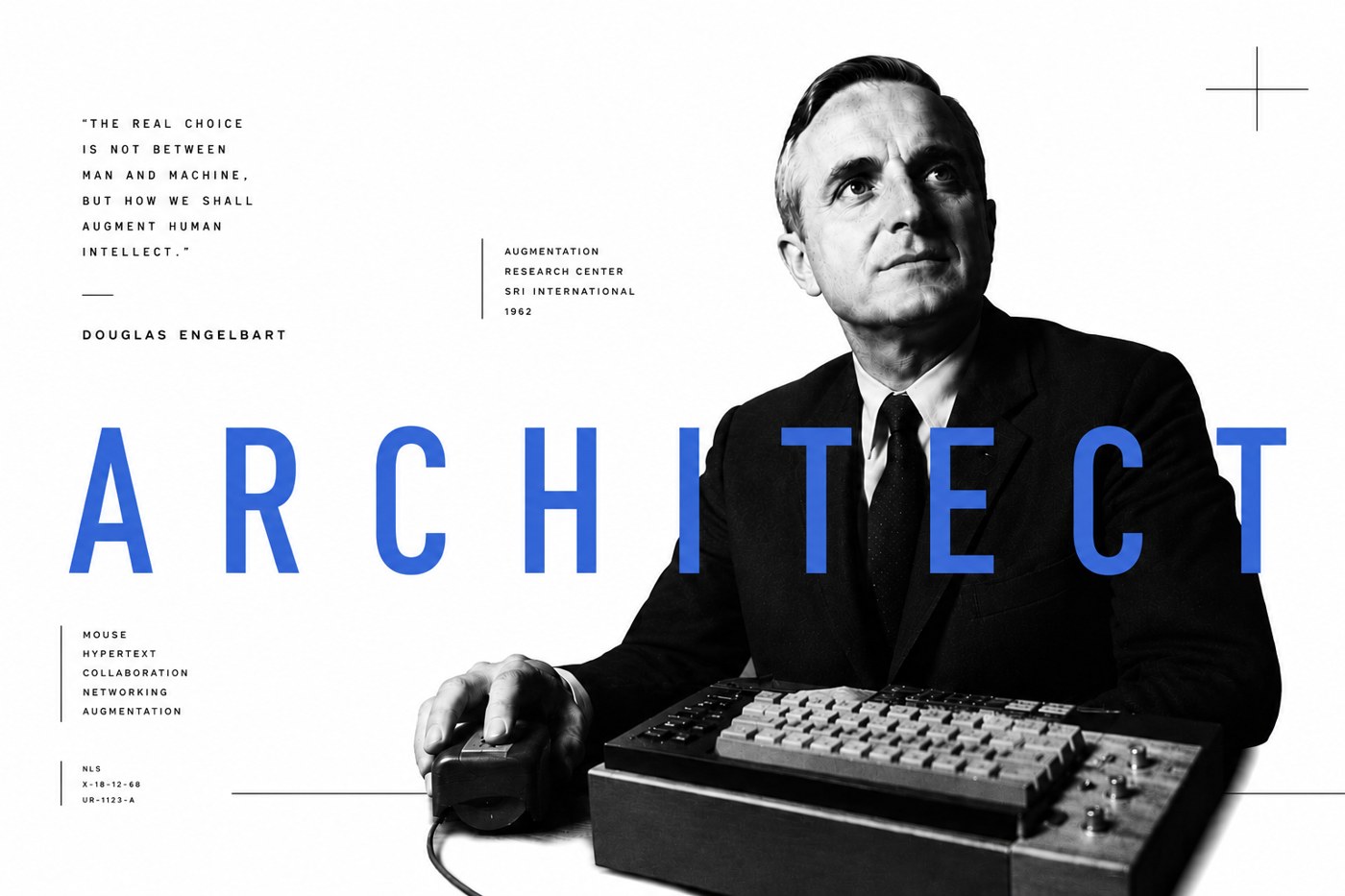
In 1960, an engineer wrote two pages about shrinking transistors. It is one of the most useful things I have read about artificial intelligence — a subject the paper never mentions, and could not have. In 1960 the future was a question of arithmetic.
Its title is deliberately unglamorous — Microelectronics and the Art of Similitude — and you will not find it on any reading list. It survives mostly as a citation in the digest of a circuits conference: pages 76 and 77, delivered on a Friday morning that February. The author is a man most people know, if they know him at all, as the guy who invented the mouse.
That is the least interesting thing about Douglas Engelbart.
The wrong question
In 1960, the entire electronics industry was obsessed with one goal: make everything smaller. Transistors were replacing vacuum tubes. Integrated circuits were being born. Miniaturization was the race — and almost everyone treated it as a manufacturing problem, a matter of better tools and steadier hands.
Engelbart wasn’t interested in that question. He was interested in a stranger, deeper one:
What happens when shrinking something changes the rules it runs by?
That sounds like a small distinction. It is the difference between optimization and discovery — and most people never notice which one they’re doing.
Similitude
Similitude — a word that deserves to come back — is the science of scale: an established branch of engineering Engelbart didn’t invent, but knew how to point somewhere new. It asks: when you change every dimension of a thing, what else changes with it?
The answer is: almost everything.
A bridge built twice as large doesn’t just weigh twice as much. Its stresses shift. It vibrates differently. Air moves across it in new ways. Scale it far enough and the assumptions the original design rested on simply stop being true.
Circuits are no different. Shrink them and resistance changes, heat misbehaves, and noise that was once a rounding error becomes the whole story. Past a certain point you are no longer building the same machine, smaller. You are building a different machine that happens to look similar — governed by different physics, demanding a different design.
Engelbart wrote this down in 1960, in the flattest language imaginable. Shrinking a circuit, he warned, would force most devices to be modified “in ways which will baffle the intuition” built on normal-sized ones. He was describing transistors and resistors. But the shape of the claim is bigger than circuits — and the leap from the one to the other is the whole point of this essay.
Smaller horses
Here is the idea, stripped down: every technological revolution eventually reaches a point where incremental thinking stops working.
Smaller horses never became automobiles. Faster typewriters never became word processors. Sharper film never became digital photography. In each case, the winners weren’t the ones who optimized the old thing. They were the ones who noticed the old assumptions had quietly collapsed — and built for the new ones instead.
Once you see this pattern, you can’t unsee it. And you start to notice how much of what we call “innovation” is really just polishing a corpse.
You already know half of it
You’ve heard a version of this paper’s idea. It became the most quoted prediction in the history of technology.
In 1965, an engineer named Gordon Moore — then director of research and development at Fairchild Semiconductor, later a co-founder of Intel — wrote a short article predicting that the number of components on a chip would keep doubling on a steady schedule. The industry named it Moore’s Law and set its clock by it for the next sixty years.
Moore's Law · Drag the mark
Sixty years of doubling.
Grab the Chromix mark and slide it along the curve. Watch the count climb.
The line is the Moore's Law prediction — a doubling every two years from Intel's 4004 (2,300 transistors, 1971). Dots are real milestone chips. Chart by Chromix; the law is Gordon Moore's (1965).
Five years before he wrote it, Moore had been sitting in the audience at the conference where Engelbart gave the similitude talk. In 2005, for the law’s fortieth anniversary, John Markoff laid the two men side by side in the New York Times — under a blunt headline: It’s Moore’s Law, But Another Had the Idea First. The contrast that follows here is his: Moore representing the engineering trajectory that made computers exponentially more powerful, Engelbart the human one, asking what that power was for.
Here’s the part almost no one notices. Moore’s Law is the comfortable part of what Engelbart was saying — the part that promises the numbers improve on schedule, so keep building what you’re building. The industry loved that half. It poured sixty years of roadmaps into it.
The other part — that each new scale breaks the old rules and opens possibilities the old design can never reach — stayed in the room. Moore’s Law tells you the old thing keeps getting better. Engelbart’s actual point was that, eventually, it stops being the same thing at all.
We kept the reassuring prediction. We forgot the dangerous one.
Permission, not prophecy
There is a temptation, writing about a man like this, to make him a seer — to say he saw the future and everyone else was blind. That is not quite what happened, and the truer version is more useful.
By 1960 Engelbart had already been carrying his real idea for most of a decade: that people might one day sit at screens and work through problems together, with the machine helping them think. In the intellectual climate of the fifties this was not merely unfashionable. It was, to most of his colleagues, faintly ridiculous.
What the similitude work gave him was not the vision. It was permission for it. If the physics of scale meant that electronics would keep getting smaller and cheaper and more capable — not gradually, but by orders of magnitude — then the machines his idea required would eventually exist. He was not predicting a future. He was checking whether the one he already wanted was allowed. Markoff, reporting the episode in 2005, records Engelbart’s relief on finding that his ambitions were less unreasonable than everyone had been telling him.
That is the sequence, and it runs the opposite way from the legend. The vision came first. The arithmetic came second, and told him to proceed.
It also explains the thing that makes his career strange: he spent the 1960s designing for a computer that did not exist yet, and could not have been persuaded to stop, because he had done the sums.
The demo was the same idea
Two years after the similitude paper, Engelbart published Augmenting Human Intellect: A Conceptual Framework. Six years after that, in December 1968, he walked onstage in San Francisco and, in ninety minutes, showed a room of engineers the mouse, on-screen windows, hypertext links, and live collaborative editing — decades before any of it reached an ordinary desk. He wasn’t a solo act, and it matters to say so: the mouse was co-invented with his colleague Bill English, who also engineered the demo itself from the lab in Menlo Park, and a whole team at Engelbart’s Augmentation Research Center built the system he was standing in front of.
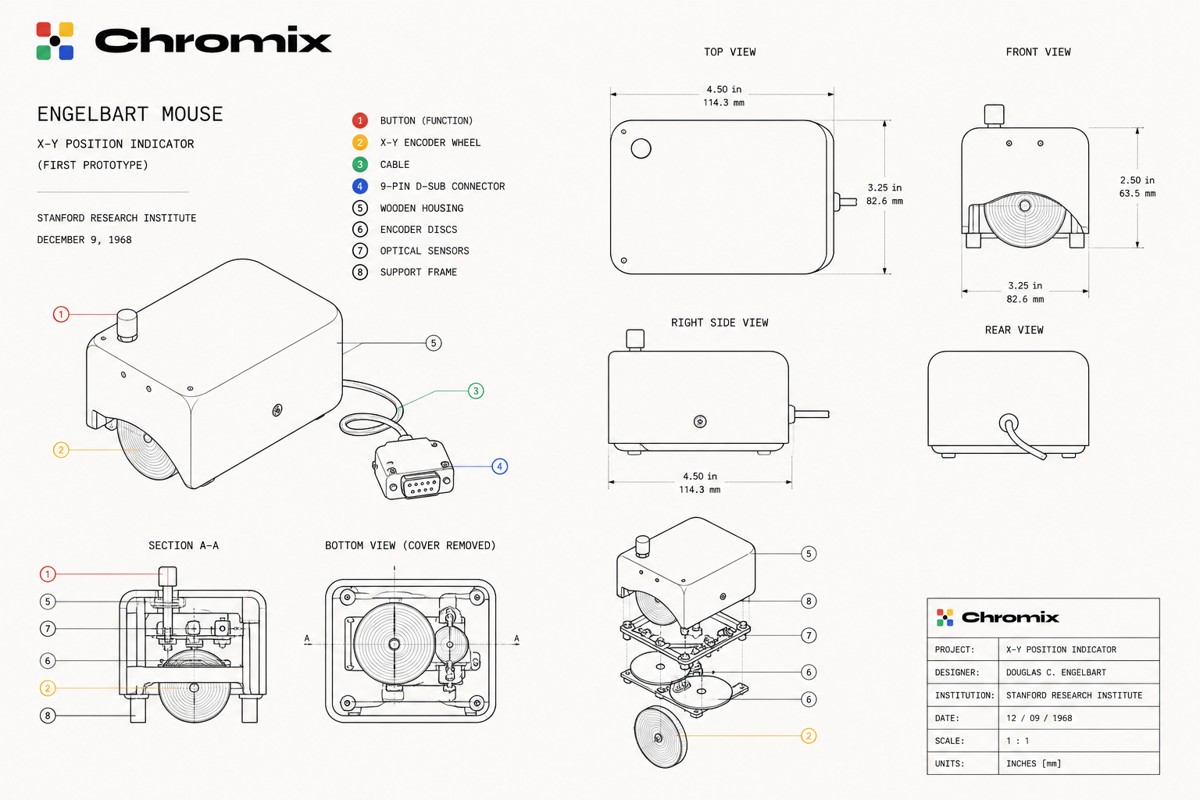
The mouse, drawn in the Chromix style — after the first prototype Douglas Engelbart conceived and Bill English built at Stanford Research Institute in 1968. Its official name, deadpan and perfect: an “X-Y position indicator.”
It’s remembered — in a phrase the journalist Steven Levy coined years later — as “the Mother of All Demos.” What he showed still describes the screen you are reading this on.
He was not always right, and the record should say so. Three years after the demonstration, when several of his own engineers wanted to reimplement NLS as a distributed network, Engelbart argued to stay with time-sharing. The man who saw one change of scale coming did not see the next one — a story told in the companion pieces on the 1968 demonstration and on Xerox PARC.
But the machines were never the point. The demo was the 1960 insight, grown up. Engelbart had understood what his peers hadn’t: when technology changes scale, humans have to change how they think — and the job of the computer was not to automate our calculations but to amplify our minds. He wasn’t building a faster adding machine. He was building a new kind of thinking.
The objection he would have raised
Before going further, an honesty note this essay owes him.
Engelbart would have objected to the next few pages. John Markoff, who spent years reporting on him, records that he came to see the artificial intelligence community as his philosophical enemy: their project was to replace human beings with machines, and his was to extend and empower them.
So the claim here is narrow, and stranger than a borrowed endorsement. He did not tell anyone how to build AI. He worked out what happens when a resource changes scale by orders of magnitude, and he spent the rest of his life on what such a change was for — while arguing against the people building toward it. The industry inherited their capability and none of his purpose. That is the problem this essay is about.
Read on with him objecting in the margin. He earned the right.
Intelligence is the new transistor
We are living through another scaling revolution. Only this time the resource becoming suddenly, absurdly abundant isn’t transistors.
It’s intelligence.
A warning about that sentence, because the essay turns on it and the turn is not free. What Engelbart wrote in 1960 was physics. You can calculate where a circuit’s assumptions fail — the heat, the resistance, the noise are all quantities, and similitude is a real discipline with real arithmetic behind it. Nothing equivalent exists for intelligence. Nobody can compute the scale at which the assumptions of knowledge work break, or prove that they break at all. What follows is an analogy, not a derivation, and it is doing borrowed work.
It is worth borrowing anyway, for a specific reason. The similitude claim is not really about transistors; it is about what happens to designs when the thing they were built around becomes abundant. That part does transfer, because the failure it describes is a failure of imagination rather than of materials — and the evidence for it is that we can already watch it happening.
Because the industry is making the exact mistake Engelbart warned about. Walk into almost any company and the question on the whiteboard is:
How do we add AI to our product?
That is the 1960 question. That is “how do we make the transistor smaller.” It is the question of people who think they’re living through a change in size when they are living through a change in kind.
The right question — the Engelbart question — is the opposite:
What becomes possible now that intelligence is cheap?
AI is not a feature you bolt onto yesterday’s software. Most of what ships with “AI” in the name is a smaller horse: the old product, lightly optimized, with a chatbot stapled to its side.
To see why that is a category error rather than a missed opportunity, it helps to be concrete about what the old designs assumed.
Almost every tool you use was shaped around the scarcity of a particular thing: attention that had to be rationed, expertise that had to be hired, and the fact that reading a hundred documents cost a hundred times what reading one did. Software was built to economize on all three. Menus exist because a person cannot hold every option in mind. Templates exist because writing from nothing is expensive. Search returns links rather than answers because judging a hundred sources was work only a human could do, so the machine handed them over and let you pay the cost.
Make the scarce thing abundant and those decisions stop being neutral. They become load-bearing walls in a building nobody needs that shape anymore. A menu is a way of rationing attention; if the system can hold every option itself, the menu is not a convenience, it is a leftover. Search results are a way of splitting labour between a machine that could retrieve and a human who had to judge; if judgement is no longer the expensive half, the whole arrangement is upside down.
This is the shape of Engelbart’s warning, transposed: past a certain point you are not running the old design faster. You are running a design whose reason for existing has quietly expired, and adding intelligence to it makes it better at being obsolete.
Redesign from first principles
The people who actually move things forward have always understood this. The Wright brothers didn’t build a lighter wagon. The engineers who built the first photographic sensors weren’t making sharper film. Engelbart didn’t build a quicker calculator. Each looked at a technology that had changed scale and had the nerve to ask what it made newly possible — then built for that, from nothing.
The rest of us mistake optimization for innovation. We improve what exists. We speed up workflows. We automate yesterday. It feels like progress, and sometimes it is. But every so often the ground shifts so completely that the old questions stop mattering — and clinging to them is the surest way to be left behind.
That is the real lesson buried in Microelectronics and the Art of Similitude. Not that electronics get smaller. That every revolution eventually reaches the moment when the old assumptions collapse, and the future goes to whoever is willing to start over.
The loop he was really drawing
Late in life, Engelbart kept returning to a single diagram: a box with an arrow that leaves it, curves around, and feeds back into itself. Inside the box, three words — improving collective IQ.
He called it bootstrapping, and it’s the key to everything else he did.
The idea is deceptively simple: the better we get at getting better, the faster we get better. Most tools make a task easier. A bootstrapping tool makes you better at improving your tools — which makes you better at improving the next thing, and the next, compounding. The output isn’t a product. It’s a smarter version of the people using it, looping back on itself and accelerating.
Diagram recreated by Chromix, after Douglas C. Engelbart’s “Bootstrapping” slide. The idea and the words are his: the better we get at getting better, the faster we get better — a feedback loop whose product is a rising collective IQ. And, as he added on the slide, “just think of the important role for technologists.”
Read that box again with AI in the room.
We have just built the most powerful bootstrapping tool in history — something that could, in principle, help us get better at getting better faster than anything before it. So Engelbart’s question arrives with full force: are we pointing it at the loop, or at the convenience? Are we using abundant intelligence to make ourselves collectively wiser — or just to make the feed harder to put down?
Bootstrapping · Run the loop
The better you get at getting better…
Team Grind just builds — one unit of work, every round. Team Bootstrap spends part of each round getting better at building, then builds with what's left. Set how much it reinvests, then run the rounds.
Bootstrap pulled ahead on round 5. It’s now 60.0× better at building — producing 42.0 per round to Grind’s 1. Same effort. It just got better at getting better.
"The better we get at getting better, the faster we get better."— Douglas Engelbart. The idea and the words are his; this loop is ours to play with.
He even named whose job this was. Beneath the loop, on the same slide: and just think of the important role for technologists. He was talking, across sixty years, to the people building right now.
To you.
One answer, offered honestly
It would be cheap to ask what becomes possible and then leave. So here is one answer, held loosely — not a prediction, and not the only one available.
Engelbart’s own answer to the last abundance was not a product. It was a claim about people: that using these tools well is a skill, something a group trains at deliberately and gets measurably better at over years, the way a surgical team or a flight crew does. He expected new roles, new training, new institutions built around getting better at thinking together. That is the part nobody built. It was never a technology problem, which is exactly why the industry could not sell it.
The same gap is open now, and wider. There is no craft of working with abundant intelligence — no apprenticeship, no standards, no shared account of what good practice even looks like. There are prompt tricks and vendor demos and a great deal of confident advice, and almost nothing that would qualify as a discipline. Anyone doing serious work this way right now is improvising a method in private and cannot compare notes, because there is no vocabulary to compare them in.
That is not a small absence. It is the same absence Engelbart spent forty years pointing at, arriving on schedule, at a larger scale. And it is buildable — not by a model, but by people willing to work out what the practice is and write it down.
Which is a less exciting answer than a new kind of product. It is also the one with sixty years of evidence behind it.
Epilogue
The paper runs two pages. On its surface it is a careful piece of engineering — dimensional analysis, Pi terms, the arithmetic of shrinking a network. But buried in its final paragraph is the whole argument: the shift in physics at each new scale doesn’t only retire the old devices, Engelbart notes — it opens fresh possibilities at every new scale, for anyone willing to stop scaling the old thing and build for the new one. Its influence runs through nearly everything that followed in modern computing, and almost no one has read it.
In 1960, Douglas Engelbart gave a talk about microelectronics.
He was describing the future of human intelligence. We’re still not listening.
Sources and corrections
The paper. Douglas C. Engelbart, “Microelectronics and the Art of Similitude,” 1960 IEEE International Solid-State Circuits Conference, Digest of Technical Papers, Vol. III, pp. 76–77, presented Friday 12 February 1960 (Session VII, chairman J. R. Nall, Fairchild Semiconductor). doi:10.1109/ISSCC.1960.1157297.
The 1951 vision and the sequence. Engelbart’s ambition to put people in front of screens working through problems together dates to the early 1950s, well before the similitude work; the account here — that the scaling arithmetic gave him confidence rather than the idea — follows Markoff’s 2005 reporting and Engelbart’s own recollections. His remark about being relieved that the idea was less crazy than he had been told is reported by Markoff; because this article could not consult the original, it is paraphrased rather than quoted, and should be replaced with his recorded words from the Doug Engelbart Institute oral histories when available.
The Moore connection. Gordon Moore was present in the audience at that conference, and was director of research and development at Fairchild when he wrote “Cramming more components onto integrated circuits” for Electronics in 1965. The link was reported by John Markoff, “It’s Moore’s Law But Another Had The Idea First,” The New York Times, 18 April 2005. Whether Moore drew on Engelbart’s talk is not established, and this article does not claim he did — only that both ideas were in the same room.
Engelbart and artificial intelligence. That he came to regard the AI community as his philosophical opponent — their aim to replace human capability, his to extend it — is reported by Markoff in What the Dormouse Said (2005).
The demonstration. Treated at length in the companion piece. The mouse was co-invented by Engelbart and Bill English at SRI; “the Mother of All Demos” was named retroactively by Steven Levy.
Similitude itself. Engelbart did not invent the theory of scale; the paper draws on Glenn Murphy, Similitude in Engineering (The Ronald Press, 1950). Credit where it was due, all the way down.
What is argued rather than reported. The reading of Moore’s Law as the comfortable half of Engelbart’s insight, and the application of similitude to abundant machine intelligence, are this article’s arguments, not claims Engelbart made. He was writing about transistors. The article says so in the text as well: the 1960 paper is physics with arithmetic behind it, and the extension to intelligence is an analogy that cannot be computed. Readers should weigh it as one.
Outstanding before publication. Confirm the quotation from the paper against the ISSCC digest rather than a secondary source, and the wording of the bootstrapping slide against the original.