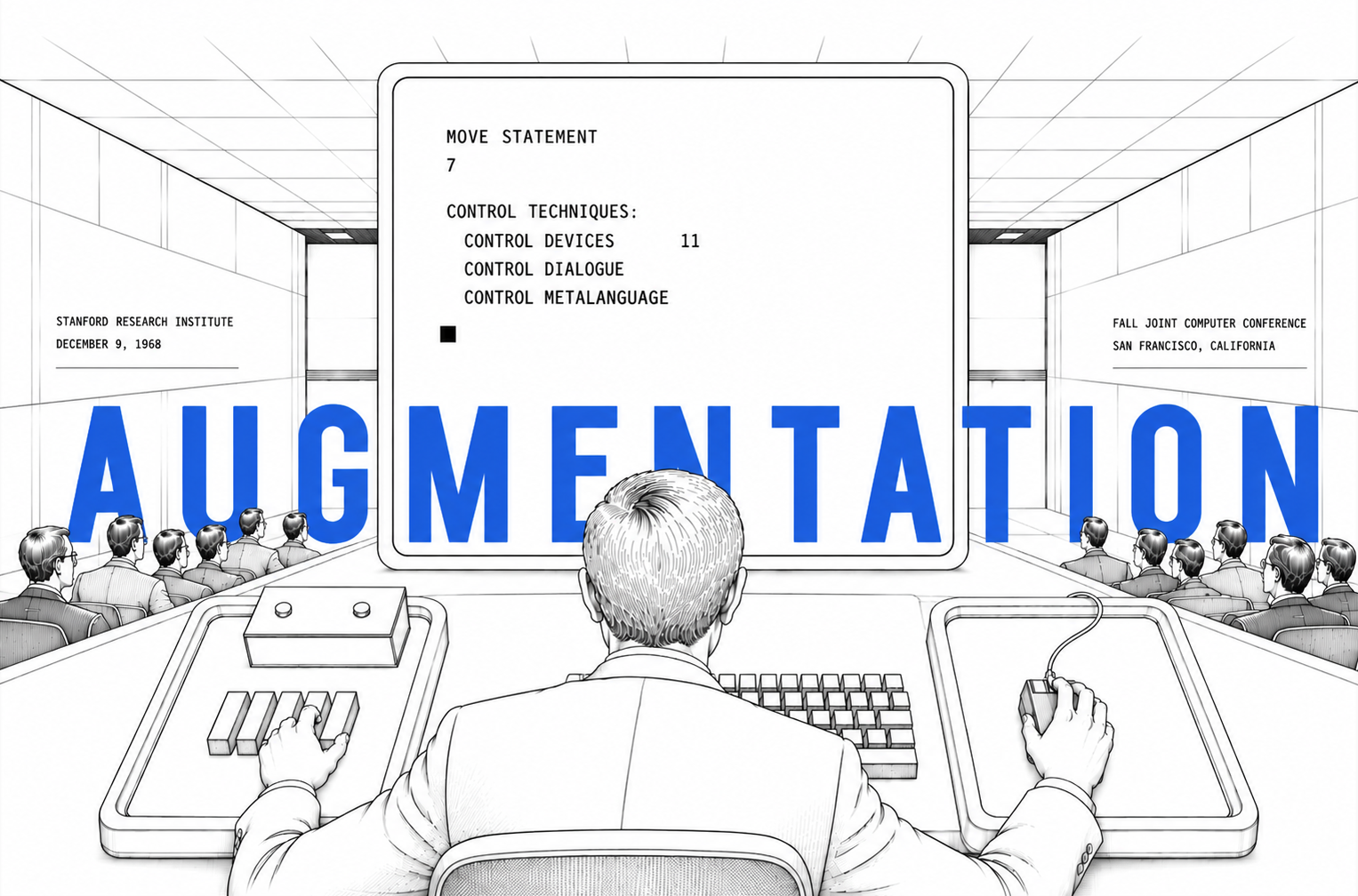
Everything you do alone at a computer was demonstrated in a single afternoon in 1968, and reached you within sixteen years. Everything you do with other people at a computer was demonstrated the same afternoon, by the same man, on the same screen — and took closer to forty.
That is not a story about technology being hard. Both halves worked that day, in the same ninety minutes, on the same machine. One of them had a buyer.
Douglas Engelbart sat down at a console in San Francisco in front of an audience of about a thousand computer professionals, most of whom had no particular reason to believe him. In front of him: a keyboard, a small five-key device for his left hand, and a wooden block with two wheels underneath that his team had taken to calling the mouse. Behind him, a screen twenty-two feet high, fed by a projector on loan from NASA’s Ames Research Center. Thirty miles south, in Menlo Park, sat the computer that would actually do the work, and the colleagues running it.
If the next ninety minutes worked, he would hand this room the future. There were a hundred ways to fail, most of them routed through a leased data link and a live video relay nobody had attempted at this scale.
It worked. Nearly all of it. Then the industry went shopping.
The rig · 1968
The computer was thirty miles away.
Engelbart sat at a console in San Francisco. The machine answering him sat in Menlo Park. Between them: a leased phone line going south, and video coming back over a microwave relay parked on a ridge.
December 9, 1968 · Re-enact the demo
You're the mouse. Move it.
Drag the Chromix mark on the console in front of you. The cursor moves on a screen thirty miles away — and selects the words you point at. In 1968, this was witchcraft.
point at a word
That's the moment that stunned the room: the thing you touch and the thing that responds are in two different places, wired together. Move an input here; a machine acts there.
What the room was used to
To feel the size of what happened, you have to feel how strange it should have looked.
In 1968, a computer was a room. You did not sit at one; you submitted to one — instructions onto punch cards, the stack handed to an operator, a printout collected later. It did not have a screen you pointed at. It did not have a screen at all, in the sense you mean. Computers were for numbers: payrolls, missile trajectories, census tables. The idea that one might be a place where you thought — where you wrote and edited and followed an idea across documents — was barely a view at all.
Barely, but not quite never. In 1945 Vannevar Bush had described a desk that let a researcher trace associative trails between documents, and Engelbart, reading it in a Red Cross library in the Philippines, took it as a starting point he never really put down. In 1960 J.C.R. Licklider published an argument for man-computer symbiosis, and then did something rarer than publishing: from inside ARPA he paid for the work, Engelbart’s lab among it. In 1963 Ivan Sutherland‘s Sketchpad had a person drawing in conversation with a machine.
So there was a tradition — small, funded by one agency, and persuasive to almost nobody outside it. Engelbart’s contribution was not being alone in the thought. It was building the thing and putting it on a stage.
His conviction was specific: that the point of the computer was not to calculate faster but to augment human intellect — to make the people using it smarter, together. He’d laid it out in a 1962 report with that phrase in the title. Hold onto the last word. It is the one the industry dropped.
Ninety minutes that shouldn’t have held together
The system was called NLS, the oN-Line System. On the giant screen, the audience watched Engelbart do things no one in that room had seen a computer do.
He moved a cursor by sliding the little wooden mouse — a pointing device the audience had no name for and no reference for. Then he used it. He edited text in place. He collapsed a list into a heading and opened it again. He clicked a word and jumped somewhere else entirely — hypertext, decades before anyone would call it that or wire it across a planet. He worked in more than one window at once.
Read as a list, these are unremarkable; you have done four of them today. That is the problem with describing them.
What makes them strange again is knowing what was answering him.
The computer was not in the room. It was in Menlo Park — an SDS 940, built out of an SDS 930, a machine that shipped as three cabinets of thirty cubic feet each and weighed something like thirty-two hundred pounds. The 940 added memory management, disk, and drum on top of that, so the real installation was larger still. It held, at absolute maximum, 192 kilobytes of core memory. Not per person. Total. Everyone at the Augmentation Research Center, Engelbart’s lab at SRI, shared it, which is what time-sharing meant and why it was radical.
The phone in your pocket has roughly forty-four thousand times that memory, in something seven thousand times lighter, and you share it with no one.
This is the part that’s easy to get backwards. The distance wasn’t a stunt — it was the constraint. You could not put that machine next to a person, so if a person was going to work with a computer all day, the computer had to reach them. Leased lines and a microwave relay strung between two cities existed because the alternative was moving a room.
What Engelbart was arguing, to a room that mostly still submitted its work on cards, was that this was worth doing anyway. Not that computers would get small — he had no particular claim on that. That a machine answering you instantly, all day, was worth the absurd expense of the wiring. And the expense only made sense for the reason he’d wired it in the first place: not so one person could have a computer, but so people in two counties could work inside the same one.
The room-sized computer is the setup. Hold the punchline.
The only way to feel 1968 is to be handed the thing and given a job.
December 1968 · Move a statement
Two keystrokes, and the paragraph moves.
Nineteen items, in the order he thought of them. To move one, type M then S — Move Statement — then pick the item and where it goes. Watch the command window finish your words before you do.
File empty. Every statement filed.
Destinations
Type M to begin. (On a touch screen, tap the keys above.)
Every character, exactly.
Two keystrokes. That is the part to sit with. Not that he could reorder a list — you can reorder a list on paper, with scissors — but that the reordering cost almost nothing, so it could be done constantly, mid-thought, as a way of thinking rather than a way of tidying. A document stopped being a record of finished thought and became a place to think.
Everything you just did is on the machine in front of you. That is the half of the demo everyone remembers, and it is not the half Engelbart was there to show.
The half nobody took
The part he cared about came later in the ninety minutes, and it is the part that gets a sentence in most retellings.
He brought in his team — live — from thirty miles away. The screen split; a colleague’s face appeared; the two of them edited the same document at the same time, each able to see the other’s changes and pass control back and forth. Whether this was the first video link of its kind depends on how you define the category, and the firsts are argued over. What isn’t argued over is that a public audience in 1968 watched two people thirty miles apart work inside one document, and had no framework for it.
The engineering underneath reads today like a dare. Commands travelled to Menlo Park over a 2,400-baud modem link. The picture came back over leased lines and a microwave relay, and reached the screen through the borrowed NASA projector. Little of it was off-the-shelf. Much of it had been built, by hand, for one afternoon.
It was not a solo performance, and this piece would be dishonest to pretend it was. The mouse had been invented four years earlier by Engelbart and his colleague Bill English, who directed the production’s technical elements from the Menlo Park end like a film shoot. The faces that appeared on screen belonged to Jeff Rulifson and Bill Paxton, editing the shared document live from ARC. A team of roughly seventeen made the ninety minutes cohere. A young Stewart Brand — soon to publish the Whole Earth Catalog — ran a camera.
Which is the point, and the sentence most retellings spend on it. The demo wasn’t a man showing off a pointing device. It was a demonstration, in its own construction, of the argument: that serious work is collective, that a mind is amplified most by other minds, well-tooled and well-connected. The mouse was the means. The two people in one document were the thesis.
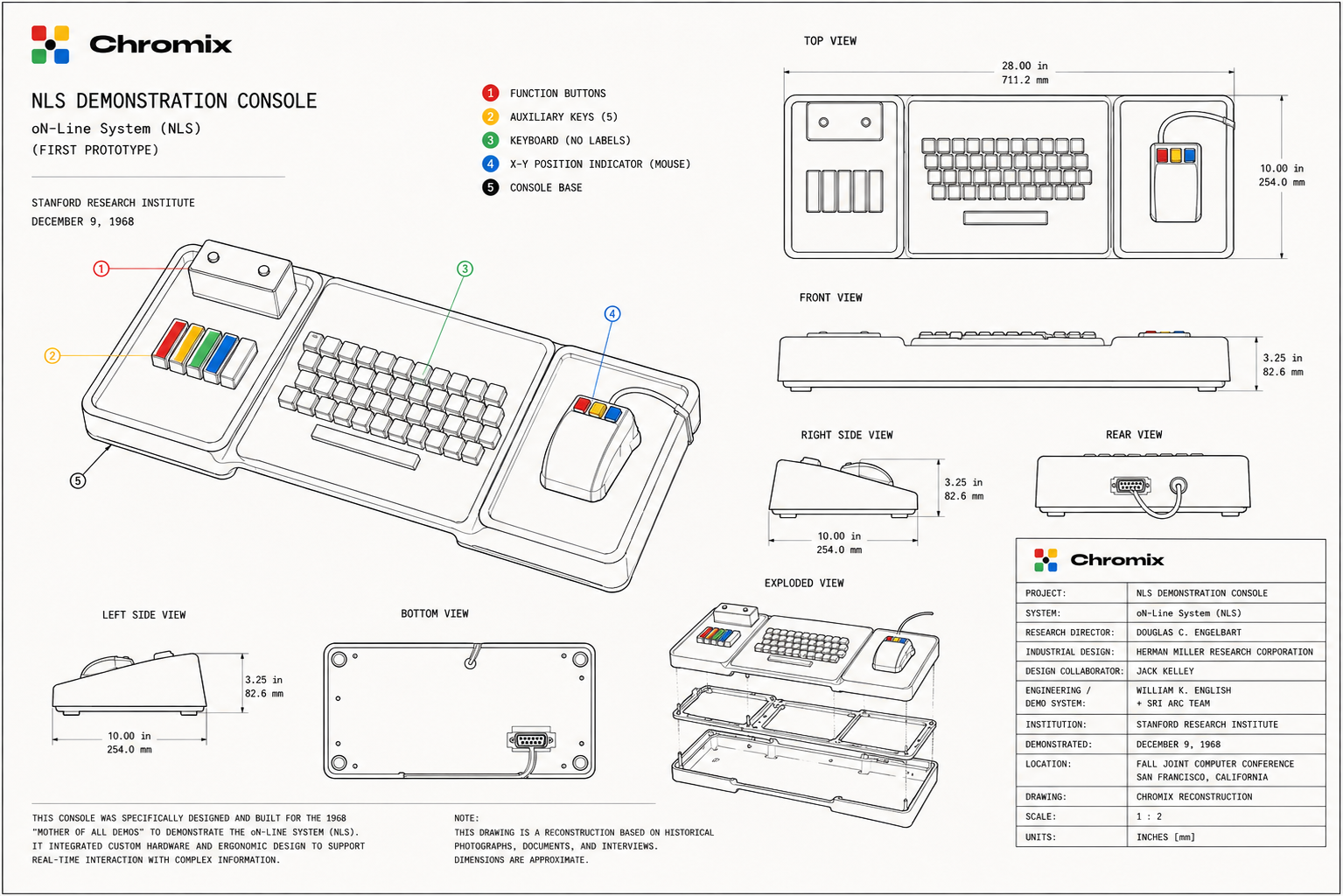
The console, drawn in the Chromix style — Engelbart’s three-input rig laid out in full: the five auxiliary keys under the left hand, the unlabelled keyboard, and the device the drawing still calls an “X-Y position indicator.” A reconstruction from photographs, documents and interviews rather than a photograph itself, so the dimensions are approximate.
When it ended, the room gave him a standing ovation. The often-repeated line about Engelbart “dealing lightning with both hands” has been attributed by several routes, which is its own small lesson in how origin stories harden. What the recording shows is a room that had just watched something it had no vocabulary for.
In the audience was a graduate student named Alan Kay, who by his own telling travelled to the conference while ill rather than miss it. Kay would go on to help invent personal computing himself. The demonstration hit him like scripture: “To me he was Moses opening the Red Sea,” he said years later.
The fork
Here the usual story says and then the world took thirty years to catch up, as though the delay were a matter of patience. That is too kind. The world didn’t fall behind Engelbart — it went a different way.
When Engelbart’s lab began to disperse, many of its people carried the ideas a few miles to Xerox PARC, where NLS’s mouse-driven navigation was rebuilt into a true graphical interface on a machine called the Alto. From there the trail runs, less straight than it’s usually drawn, toward the people who shipped it. Steve Jobs‘s 1979 visits to PARC are well documented and their influence on the Macintosh is not seriously disputed. The personal computer arrived, and it was extraordinary, and it made hundreds of millions of individuals more capable than they had ever been.
It also, in Engelbart’s reading, walked away from the thing he had built the demo to prove.
He wrote it down. In December 1988 — twenty years almost to the month after the demo — Engelbart and his colleague Harvey Lehtman published an essay in BYTE called “Working Together,” unsparing about the revolution then in full flood. The personal computer, they wrote, delivered enormous gains in individual productivity and creativity while causing real setbacks in tools for organizational effectiveness — the group tools that had grown up on the older time-sharing systems. In emphasizing the power of the individual, they said, the revolution “turned its back” on tools for people working together on shared knowledge over time.
Not hasn’t got there yet. Turned its back. That is a man watching an industry make a choice, and naming it.
Look at the two lanes and the choice is visible. The pieces of the demo that made one person more capable shipped within sixteen years. The pieces that made people together more capable took closer to forty. Same demo. Same afternoon. One half had a business model and the other one didn’t.
The long way round
The strangest part is that we came back for it.
By 1991, Jobs was arguing publicly that individual productivity was no longer enough — that the real advantage of the coming decade would come from improving how groups worked together. Three years after Engelbart wrote that the industry had turned its back on exactly that. The shared document, the video call, the comment thread, the co-edited file open in your other tab right now: all of it is the collective half, rebuilt from scratch, decades late, by people mostly unaware they were reconstructing something that had already been demonstrated once.
And even now the reconstruction is partial. Andries van Dam, who spent his own career on these tools, put it plainly four decades on: “NLS hasn’t really been realized with the mainstream market.”
Why so partial? Because the collective half was never about features. Engelbart’s claim was harder than software: that using these tools well is a skill, something a group trains at over years, the way a surgical team or a flight crew does. He expected people to get better at thinking together, deliberately, with practice. The industry could ship him a shared cursor. It could not ship him that.
So it shipped the cursor. Reading the fork as a choice about business models rather than a failure of engineering is this essay’s argument, not his — Engelbart framed the shortfall as unfinished work, and kept trying to finish it until he died in 2013.
It is worth saying plainly who turned first. Not Xerox, not Apple, not the market. Several of Engelbart’s own engineers — including the men who had built and run this demonstration — wanted to reimplement NLS as a distributed network, and Engelbart wanted to stay with time-sharing. They left for Palo Alto in 1971 over that disagreement, and what they built there is what ended up on everyone’s desk. The turn away from the centralized model began among the people who had just finished proving it worked. That story is told in the companion piece on Xerox PARC.
What we are doing right now
Which brings this uncomfortably close to home.
We are adopting a new class of thinking tool at a speed the 1980s could not have imagined — and adopting it, mostly, the same way. Individually. One person, one window, one conversation. The gains are real and they are personal, exactly as the personal computer’s were. Whether any of it makes a team measurably better at thinking together, whether anyone is training at it the way Engelbart meant, is a question almost nobody is being paid to ask.
The pattern isn’t that the future arrives late. It’s that we buy the half we can sell to one person and leave the half that would require us to change how we work.
Engelbart showed both in ninety minutes, and we have spent fifty-eight years on the easier one. The question he’d ask about the tools we have now isn’t whether they’re impressive. It’s whether we’re getting better at using them — or just getting more of them.
Sources and corrections
The demonstration. Douglas C. Engelbart and William K. English, “A Research Center for Augmenting Human Intellect,” Fall Joint Computer Conference, San Francisco, 9 December 1968. The audience figure of about one thousand, the twenty-two-foot screen, the projector on loan from NASA Ames, the 2,400-baud link, and the standing ovation are consistent across SRI International, the Doug Engelbart Institute, the Smithsonian’s Lemelson Center, and DARPA’s account. Sources differ on the exact venue within San Francisco, so it is not named here. The mouse was co-invented by Engelbart and Bill English at SRI in 1964; the demonstration was the work of the roughly seventeen-person Augmentation Research Center, with Jeff Rulifson and Bill Paxton editing remotely from Menlo Park, Bill English directing, and Stewart Brand among the camera operators.
The tradition Engelbart came from. Engelbart credited Vannevar Bush’s “As We May Think” (The Atlantic, July 1945) as a formative influence. J.C.R. Licklider’s “Man-Computer Symbiosis” appeared in 1960; ARPA’s Information Processing Techniques Office under Licklider and his successors, together with NASA, funded the Augmentation Research Center. Ivan Sutherland’s Sketchpad was demonstrated in 1963.
Hardware figures. The three-cabinet and 3,200-pound specifications belong to the SDS 930 from which the 940 was built; the 940 installation, with memory management, disk and drum, was larger. SRI’s exact memory configuration on the day is not established here, so 192 KB is stated as a maximum and the comparison figures are order-of-magnitude.
What “reached ordinary people” means. General availability to non-specialists without institutional purchase — the mouse with the Macintosh in 1984, the web from the early 1990s, real-time collaborative editing from the late 2000s. Earlier enterprise and research systems existed in every case.
Quotations. Alan Kay’s remark about Engelbart and the Red Sea is drawn from his recorded interviews and Andries van Dam’s assessment of NLS from remarks around the demonstration’s fortieth anniversary; both should be cited to the specific recording before publication. Steve Jobs’s remarks on group productivity are from his public talks of the early 1990s.
The 1988 verdict. Douglas Engelbart and Harvey Lehtman, “Working Together,” BYTE, December 1988.
A correction to an earlier framing. This article originally described the collective half of Engelbart’s vision as abandoned by the industry. The fuller picture, set out in the companion piece on Xerox PARC, is that several of Engelbart’s own engineers left in 1971 over an architectural disagreement — they wanted to reimplement NLS as a distributed network, Engelbart wanted to stay with time-sharing. The turn away from the centralized model began inside his own laboratory.
Outstanding before publication. The van Dam and Kay quotations need citation to their original recordings. “The Mother of All Demos” was named retroactively by the journalist Steven Levy.