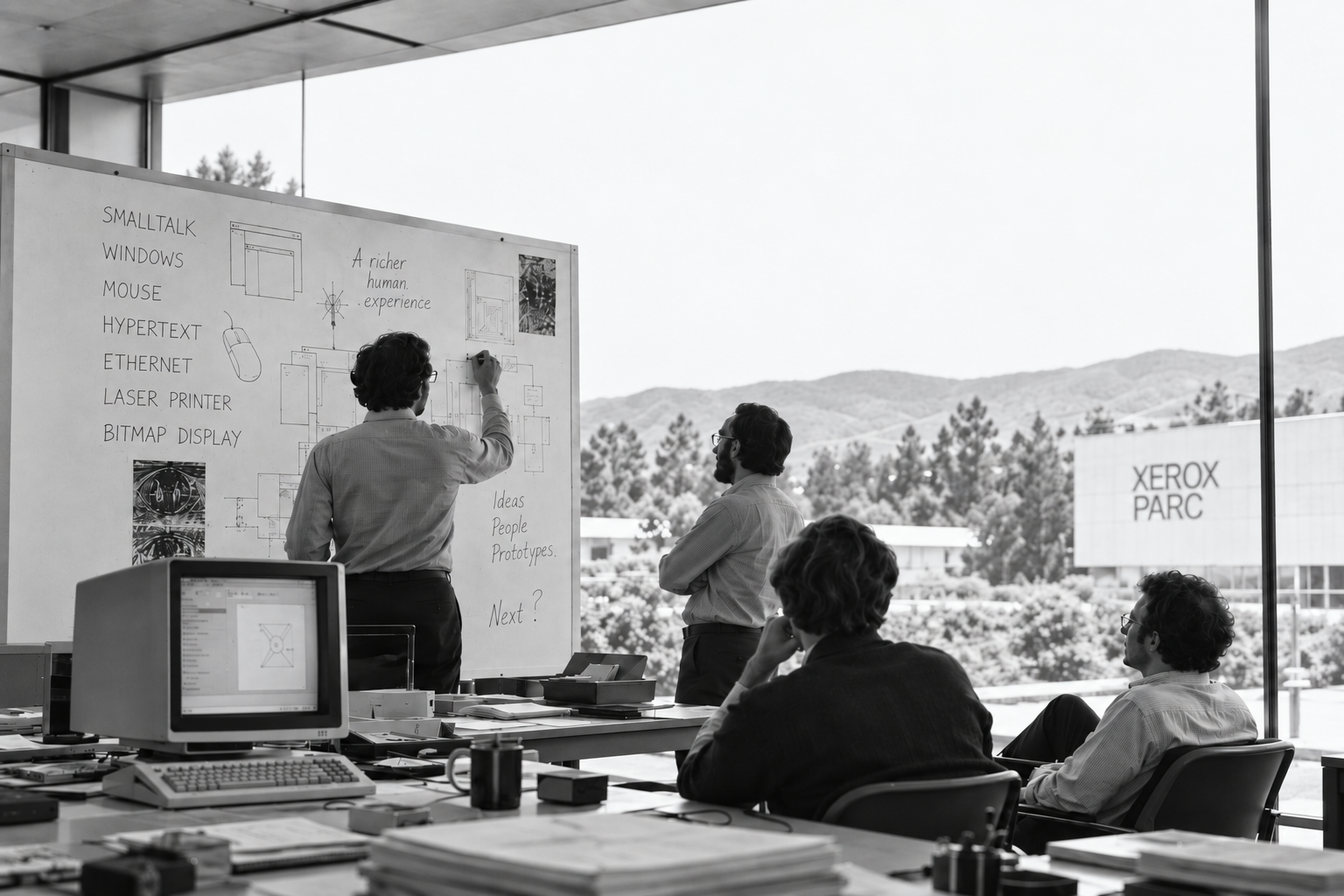
Years after he left, Gary Starkweather ran into the boss who had tried to stop him working on lasers. The man asked whether he was still playing around with that laser stuff.
By then it was a two-billion-dollar-a-year business.
That exchange is the whole story of Xerox PARC in two sentences, and it is not the story you have heard. The one you have heard is that Xerox invented the future in a lab in Palo Alto and fumbled it, handing the personal computer to its competitors through sheer corporate blindness. That version is repeated so often it has its own book title.
It is also wrong in a way that matters, and the correction is more useful than the legend.
The ledger
What PARC invented. Who sold it.
Six inventions, one laboratory, one decade. The right-hand column is the argument.
| Invention | Who made it | Who sold it | What Xerox got |
|---|---|---|---|
| Laser printing 1969–77 The one they kept. It is generally reckoned to have returned many times the entire cost of the lab. | Gary Starkweather, with Butler Lampson and Ron Rider | Xerox — the Xerox 9700 | Everything |
| Ethernet 1973 Standardised jointly with Intel and DEC. It became the way computers talk to each other. | Bob Metcalfe and David Boggs | 3Com — founded by Metcalfe in 1979, after he left | A standard it licensed away |
| The Alto 1973 Never sold. Hiltzik's account has the Alto III prepared for release and cancelled, Xerox backing a dedicated word processor instead. The Star 8010 followed in 1981 at $16,595 and was discontinued in 1985. | Chuck Thacker, Butler Lampson, and the lab | Nobody | Nothing |
| The graphical interface 1973– Jobs toured PARC in 1979; Xerox took an equity stake in Apple in exchange. That stock is the nearest thing to a return in this column — and it was not the business. | The Alto and Smalltalk teams | Apple, then Microsoft | Shares, not a product |
| WYSIWYG editing 1974– Simonyi left for Microsoft in 1981 — on Metcalfe's suggestion — and built Word there with Richard Brodie, also out of Bravo. The idea walked out in two people. | Butler Lampson and Charles Simonyi (Bravo, 1974); Larry Tesler and Timothy Mott (Gypsy, 1975) | Microsoft — Word, 1983 | Nothing |
| Smalltalk, and objects 1972–80 Object-oriented programming left the building and never came back with a receipt. | Alan Kay, Dan Ingalls, Adele Goldberg | The whole industry, uncredited | Nothing |
1 of six, brought to market by the company that paid for it
The man who funded the future, then staffed it
In 1961, as a project manager at NASA, Bob Taylor directed funding to a researcher at SRI in Menlo Park named Douglas Engelbart. He kept funding him from inside ARPA through the sixties, while Engelbart’s NLS put a mouse, windows, and linked documents on a screen in 1968.
In July 1970, at the urging of chief scientist Jack Goldman, Xerox opened a research centre in Palo Alto — three thousand miles from headquarters. That September, George Pake hired Taylor, then on sabbatical at Utah, to start a Computer Science Laboratory. He stopped funding the future and started hiring it.
Some of what he hired was Engelbart’s. The man who had built the first mouse to Engelbart’s design came to PARC and rebuilt it with a ball instead of wheels. A joke went around that Engelbart’s lab had been a training programme for PARC.
But the crucial hires came from elsewhere. In January 1971 Taylor took most of the collapsing Berkeley Computer Corporation — Butler Lampson, Chuck Thacker, Peter Deutsch and others — and it was they who built the Alto.
And here is the part worth stopping on.
Engelbart’s people did not leave only because his funding was drying up. Several left because they disagreed with him — and not in the direction you would expect.
Alan Kay, who was there, put it plainly in his history of Smalltalk: many of Engelbart’s group joined PARC because they wanted to reimplement NLS as a distributed network system, and Engelbart wanted to stay with time-sharing. Bill English, Jeff Rulifson, and Bill Paxton — the men who had built and run the 1968 demonstration — were among them.
Read that again. The man who had shown the world two people working across thirty miles of leased line was, three years later, the one arguing to keep the computer in the middle. His engineers wanted to break it apart and give everyone their own. They went to Palo Alto and did exactly that.
The fork this article is about did not begin in a Xerox boardroom. It began among the people who had run the demo, over an architecture, and it was settled before Xerox had to decide anything.
Five years, most of a computer
What PARC produced between roughly 1971 and 1976 is hard to state without sounding like exaggeration.
Lampson and Thacker built it: a machine with a bitmapped screen shaped like a sheet of paper, a mouse, and enough power for exactly one person, at a time when “one person, one computer” was a sentence requiring explanation. Kay, who had watched Engelbart’s demo as a graduate student, led the Learning Research Group, which produced Smalltalk and much of the graphical interface. Bob Metcalfe built Ethernet to wire the Altos to each other and to a printer. Adele Goldberg shaped Smalltalk and later ran the lab’s systems group. Charles Simonyi wrote Bravo, the first editor where what stood on the screen was what came out of the machine.
And Starkweather was already there. By Kay’s account he had been thrown out of Xerox’s Rochester laboratories for wanting to build a laser printer, which was against the local religion. He brought the idea to Palo Alto and had a working machine inside a year — the only copier he could get would not run slower than a page a second, so he simply made the laser keep up, at five hundred pixels to the inch.
Hold that last one. It is the key to everything that follows.
What Xerox actually did
Xerox did not fail to commercialize PARC. It commercialized the laser printer ferociously, shipping the 9700 in 1977 into banks and insurance companies that needed millions of pages a month, and it made billions.
Michael Hiltzik, who wrote the definitive history of the lab, puts the correction plainly: the idea that Xerox never earned anything from PARC is a myth, and revenues from the laser printer alone returned the company’s investment in the lab many times over. Judged as an investment, PARC is among the most successful corporate research operations ever run.
It simply paid for itself with the one invention that fit the company Xerox already was. Xerox built roughly two thousand Altos. By 1979 about a thousand were running inside Xerox and another five hundred at universities and government offices. It built a personal computer and issued it to itself.
Xerox sold marks on paper. A laser printer is a better way to put marks on paper — the salesforce understood it, the service organization understood it, the customer already had a budget line for that category. It slotted in.
The Alto slotted into nothing. And here the usual telling omits the decisive fact: by 1975 Xerox was no longer in the computer business at all. It had bought Scientific Data Systems in 1969 — the company whose SDS 940 had run Engelbart’s 1968 demonstration the year before — renamed it Xerox Data Systems, lost heavily, and shut it down. When PARC handed its parent a personal computer, it was handing it to a corporation that had just written off computing as a costly mistake.
So Xerox was not blind. It was scarred, and looking the other way on purpose.
The visit
In December 1979 a delegation from Apple walked into PARC and was shown the Alto — bitmapped screen, overlapping windows, a pointing device, text that looked on the display the way it would look on paper. Steve Jobs paced the room and asked the researchers why they were sitting on a gold mine.
Almost everything popularly believed about that afternoon is wrong, and the corrections all point the same way.
Xerox wanted the deal. The legend has Jobs talking his way past a naive corporation. In fact Xerox’s venture arm wanted a position in Apple before its imminent IPO priced it out of reach, and the trade — the right to buy 100,000 pre-IPO shares, about a million dollars’ worth, in exchange for access — suited both sides. What Xerox’s own scientists were not told was that a financial arrangement existed at all, which is where the resentment inside the lab came from.
There were two visits. After the first, Jef Raskin — who had pushed for the visits in the first place — told Jobs he had been shown a fraction of what was there. The second visit is the one that mattered.
Apple was already building it. Both the Lisa and the Macintosh were underway before December 1979, with bitmapped displays already argued for internally by Raskin and Bill Atkinson. Raskin’s motive for arranging the tour was partly to raise the standing of work Apple was already doing. Jobs did not discover the graphical interface at PARC. He discovered that it worked, and that someone else had a five-year head start on it.
The lab was split. Larry Tesler, who ran the demonstration, had long since given up on Xerox commercializing any of it and saw no reason to withhold anything. Adele Goldberg argued that showing this to engineers capable of understanding and exploiting it would be a serious error. Goldberg was correct and was overruled by headquarters. Tesler left for Apple the following July.
That last detail is the one worth holding. The most consequential thing Apple took from PARC was not a design. It was the people — Tesler among them — who had spent a decade learning what the design was for.
Xerox made money on the trade. Its shares were worth many times the million it paid by the time Apple went public in December 1980. It made money and lost the industry, which is a strange sentence until you remember the company had already decided not to be in that industry.
And it did try again. The Star shipped in 1981 with a graphical interface, networking, and printing — three years before the Macintosh — at about $75,000 for a basic system, with each additional workstation around $16,000. A complete office installation ran between $50,000 and $100,000, at a time when a secretary earned about $12,000 a year. Apple’s Lisa, aimed at the same job, launched at $10,000 in 1983 and also failed. The Macintosh, a year later at $2,495, did not. The lesson took two commercial failures and five years to learn, and Xerox was not around for the end of it.
Price as the barrier
The idea was fine. The price was the product.
Set a yearly salary and watch what a year of pay has left in it after the machine. The interface was the same in all three.
-
Xerox Star 1981$75,000
Basic system — workstations, file server, print server, Ethernet. Not one machine.
—
-
One Star workstation 1981$16,595
A single 8010 with its software — the fairest like-for-like against a desktop.
—
-
Apple Lisa 1983$9,995
The first sold at scale carrying the interface. It failed anyway.
—
-
Apple Macintosh 1984$2,495
Substantially the same idea, a thirtieth of the Star system.
—
Microsoft arrived by another road, with Charles Simonyi eventually leaving PARC for Redmond to build the word processor that made WYSIWYG ordinary. Bill Gates later put the whole affair to Jobs more precisely than either legend allows: they had both had a rich neighbour named Xerox, and Gates had broken in to steal the television only to find that Jobs had already taken it.
What it leaves us
The lesson usually drawn is protect your inventions. That is the expensive lesson, and it produces companies that hoard research and ship nothing.
The narrower one: an organization can only ship what its existing business can recognize. Everything else it invents will leave — not through theft, but through indifference, walking out with the researchers into companies organized around that one idea. Apple could sell the Alto’s ideas because Apple was already the personal computer business. Xerox could sell the laser printer because Xerox was already the paper business. Neither is a moral failing. Both are a description of what a company is able to see.
This rhymes with 1968, the subject of the companion piece to this one. Engelbart demonstrated two futures in ninety minutes and the industry took the one it could sell to a single person. PARC invented several and Xerox shipped the one it could sell to the customer it already had. In neither case was the problem that nobody noticed. A working demonstration has no salesforce, no category, and no budget line — and those, not whether the thing works, decide what reaches people.
Which raises the question worth carrying out. If you are making something your own organization has no way to sell — no category, no customer, no line on the forecast — the invention is not the hard part. You have done that part.
The hard part is that you will have to build the thing that sells it, too.
Sources and corrections
The lab and its people. Bob Taylor directed NASA funding to Douglas Engelbart at SRI in 1961 and continued supporting his work from ARPA’s Information Processing Techniques Office, which he directed from 1965 to 1969; he ran PARC’s Computer Science Laboratory from 1970 to 1983. PARC was founded under Xerox chief scientist Jack Goldman and opened on 1 July 1970. The January 1971 recruitment of the Berkeley Computer Corporation group — Lampson, Thacker, Deutsch and others — and Gary Starkweather’s expulsion from Xerox’s Rochester laboratories for pursuing laser printing are both from Alan Kay’s first-hand account in “The Early History of Smalltalk” (1993). Bill English’s move from SRI to PARC and his redesign of the mouse with a ball mechanism are documented by SRI International and the Computer History Museum.
The disagreement inside ARC. Alan Kay, “The Early History of Smalltalk,” ACM SIGPLAN HOPL-II, 1993, states directly that many of Engelbart’s people joined PARC in part because they wanted to reimplement NLS as a distributed network system while Engelbart wanted to stay with time-sharing, and names English, Rulifson and Paxton among them. Kay was present and writing about his own colleagues, which makes this a first-hand source; it is also one participant’s account of others’ motives, and other pressures — the Mansfield Amendment, the end of Apollo, and the funding contraction that followed — were acting on ARC at the same time.
The laser printer. Michael Hiltzik, Dealers of Lightning: Xerox PARC and the Dawn of the Computer Age (1999), for the finding that laser printing revenues returned Xerox’s investment in PARC many times over, and for Starkweather’s later exchange with his former manager. Starkweather’s work at Webster from 1969, his 1971 move to Palo Alto, and the 1977 Xerox 9700 are documented by the Computer History Museum and the National Inventors Hall of Fame.
Xerox and computing. Xerox acquired Scientific Data Systems in 1969, renamed it Xerox Data Systems, and closed it in 1975 — a loss that shaped what followed, since PARC delivered a personal computer to a corporation that had just written off computing. The Xerox 8010 Star was announced on 27 April 1981 at $16,595 for a single workstation (Smithsonian National Museum of American History); a basic system ran about $75,000, with additional workstations around $16,000 each and a complete installation between $50,000 and $100,000. Alto production totalled roughly two thousand machines — about a thousand in use at Xerox and five hundred at universities and government offices by 1979 — consistent with Alan Kay’s recollection of some two thousand built. An earlier draft of this article gave Alto production as 25,000; that figure is in circulation but appears to describe Star units sold, not Altos built. It is recorded here because the error is instructive: a correct number attached to the wrong noun travels easily.
The 1979 visits. The two visits, the arrangement permitting Xerox to buy 100,000 pre-IPO Apple shares, the division between Larry Tesler and Adele Goldberg over what to show, and the fact that both the Lisa and Macintosh projects predate December 1979 are drawn from Michael Hiltzik’s reporting, Tesler’s own account at a 2011 Churchill Club panel, Jef Raskin’s contemporaneous Macintosh documents as catalogued by Stanford University Libraries, and Bill Atkinson’s later interviews. Sources differ on whether the share price was $10.00 or $10.50. Bill Gates’s remark to Jobs about the rich neighbour is recorded in Walter Isaacson’s Steve Jobs (2011) and dates to a confrontation after Microsoft announced Windows at Comdex in November 1983. Andy Hertzfeld, whose Folklore.org account is the other main source, has said he may have conflated two separate meetings; the wording is well attested, the setting less so.
The opposing view. Douglas K. Smith and Robert C. Alexander, Fumbling the Future: How Xerox Invented, Then Ignored, the First Personal Computer (1988), is the standard statement of the thesis this article argues against, and is worth reading against Hiltzik rather than instead of him.
Outstanding before publication. One figure remains genuinely unsettled: the price at which Xerox was permitted to buy Apple stock, given variously as $10.00 and $10.50 a share. Hiltzik gives the higher figure. The article states the arrangement without the per-share price for that reason. Anyone with access to the original agreement is invited to write in.
Further reading. Thierry Bardini, Bootstrapping: Douglas Engelbart, Coevolution and the Origins of Personal Computing (2000), is the scholarly biography treating Engelbart’s relationship to the personal-computer era at length. Not a source for anything above — somewhere for a reader to go next.